Showing posts with label Dystopian. Show all posts

Monday, 28 April 2025

Sunrise on the Reaping, Suzanne Collins


Book Title: Sunrise on the Reaping
Author: Suzanne Collins
Series: The Hunger Games #0.5
Date Started: April 24th  2025
Date Completed: April 28th 2025
Genres: Dystopian, Action, Adventure
Quality Rating: Five Stars
Enjoyment Rating: Four Star
Final Rating: Four Stars
Review:

This book seemed to come out of nowhere in the wake of the Ballad movie, and yet it's oh so timely. Collins is not only taking a beloved character like Haymitch and portraying a nearly unrecognisable yet wholly aligned character arc, she's adding to her tapestry of what dystopia really means. It felt like things built slowly at the start, and then all at once - but looking back, everything had its place in an impressive performance.

Suzanne Collins only writes when she has something to say? By the time of publication, one would wonder how she could have possibly predicted the current state of the world the book would be born into. But of course, she could, she's been saying it from the beginning. This is what sets her dystopian world apart from all the others; there is an intrinsic recognition of where we in contemporary culture sit in her narratives, and the slippery slope we stand on in privileged countries. The way we access media, how we view others, the lasting importance of the 'posters' we do or do not ignore. You think you're Haymitch or Katniss or Lucy Gray? Look again, because that's not the story you're being told.

The references to other events in the series are frequent but mostly ungratuitous. It's such an interesting place to tell a story in the timeline, between generations but at a point where everything we know about the world and characters is in play as we race towards what's coming, and see how what has come before has made it so. Collins knows this and, other than a few off-hand unnecessary name drops, she's only strengthening a story I'm convinced she knew right from the beginning.

As much as the social commentary and Collins' talent for thrilling action, this book is also just enjoyable to read. I raced through it, having bought it on a whim on a bad day, and funnily enough stories about dystopia but people keeping their humanity within them was just what I needed. The epilogue was truly moving, and oh I would love to write an essay on the use of music in these books, its place in social resistance, traditional storytelling and artistic freedom. I'm very glad Collins has continued to lean into this, and I can't wait to see Francis Lawrence bring it to life on the big screen.

Sunday, 2 March 2025

The Dark Mirror, Samantha Shannon


Book Title: The Dark Mirror
Author: Samantha Shannon
Series: The Bone Season #5
Date Started: February 26th  2025
Date Completed: March 2nd 2025
Genres: Fantasy, Romance, Adventure, Action, Dystopian
Quality Rating: Four Stars
Enjoyment Rating: Five Stars
Final Rating: Four Stars
Review:

It's been a long time coming, but it's finally here. I was so ready to dive back into Paige's adventures that it took mere pages for me to be addicted again. I devoured chapters at a time and read the whole thing in 4 days despite its length. My inner mythology and archaeology nerd was spurred on even faster, and I lapped up the references and inspiration from Rome, Venice and beyond.

I appreciated the reminders of previous events threaded into the text. I would often criticise info-dumping, but it's constructive here; it's been a staggering five years since I read The Mask Falling. And for those who haven't reread the stories in the 'author's preferred texts,' don't worry. Shannon does direct readers to her website for a very short list of amendments, but it's been so long that I honestly wouldn't have batted an eye at the changes regardless.

There is a lot of talking in this book which, while enjoyable, made it feel less high stakes than what I remember of the previous books. An awful lot happens, but an awful lot of it happens off the page and outside of our protagonist's presence. That's just how it works when you have a first-person narrator, and I continue to be impressed at how the complex political and magical worlds are mostly kept accessible to the reader via the prose and Paige's inner circle's view.

I couldn't write this review without acknowledging something that I think went over my head when I was younger and reading the first books: Shannon's sense of place. She recreates real cities I've never been to as if they're outside my window and paints the places I know well with so much vibrancy it's like discovering them again for the first time. Her storytelling hinges so much on this staggering sense of reality and an instinctive desire to explore it - which Shannon allows us to in Paige's wanderings, her curiosity to seek out hidden sides of the city, and her evergrowing talent of inadvertently destroying any building she walks past. The heavy use of dialogue mentioned above almost doesn't matter; you can taste the air Paige is walking in, and that's powerful.

I'm hoping that the last two books in the series come out in closer succession to this one, as The Bone Seasion series thrives on momentum. The escalating conflict is reaching a crescendo in real time with these characters, and to throw us in in something close to real time too will make the fever pitch of whatever finale we're approaching unforgettable.

Sunday, 24 December 2023

The Ballad of Songbirds and Snakes


Book Title: The Ballad of Songbirds and Snakes
Author: Suzanne Collins
Series: The Hunger Games #0
Date Started: December 14th 2023
Date Completed: December 24th 2023
Genres: Dystopian, Action, Romance
Quality Rating: Four Stars
Enjoyment Rating: Four Star
Final Rating: Four Stars
Review:

It’s been a long long time since I read the original Hunger Games trilogy and, revisiting this series after a long time, I’m impressed by how well it holds up and how nuanced it still persists to be. Collins’ stories really are the pinnacle of Young Adult fiction, even if the genre has grown and changed in its own ways - it’s actually curious how harrowing and grim some of the original gamechangers in YA could be, but still execute heart wrenching hope. I’m not here to moan about the current landscape, but I think it’s fair to say that achieving that balance is sometimes massively underrated and often forgotten.

Prequels to existing series - especially ones about the villain’s origins - are often not for me. Many authors find it hard to write their protagonists truly escalating to the levels of predisposed evils required to fit into the main series. But damn, Collins pulls it off. The Ballad of Songbirds and Snakes is really a fantastically well executed exploration of entitlement and toxic masculinity. And one where, lo and behold, the woman doesn’t have to tragically die to motivate it!

Of course, my brain can’t help but compare it to the movie adaptation, which I saw first but did persuade me to jump back into Collins’ writing. The adaptation smooths out some of the unnecessary bulk and fiddly strings of events, but also misses the real depth of entitlement that motivates Coriolanus through most of the novel. I also found the more overt camaraderie and teamwork in the Academy students - even when pitted against each other - really interesting as that was mostly revamped into pure poisonous relationships for the film.

Similarly to how impressed I was by the film (quite by surprise I have to admit!), I’m so happy I was persuaded to read this prequel. It’s an exciting, political, well-balanced and thoroughly enjoyable addition to the original trilogy, strong enough to stand on its own with its own story but actually adding depth and understanding to just how much Snow really must hate Katniss all those years later.

Thursday, 31 December 2020

The Mask Falling


Book Title: The Mask Falling
Author: Samantha Shannon
Series: The Bone Season #4
Date Started: December 23rd 2020
Date Completed: December 31st 2020
Genres: Fantasy, Adventure, Dystopian, Sci-Fi
Quality Rating: Four Stars
Enjoyment Rating: Five Star
Final Rating: Five Stars
Review:

◆ Thanks to NetGalley for this eBook copy for review ◆

Since I read the first Bone Season novel I've loved this series, and it always takes me reading the new instalment to remember just how much I do love it (I know I still like it, but it feels like each book rekindles the same feeling of excitement again, and that's priceless). The Mask Falling has, like each instalment, been a long time coming, and I'm very happy to say I enjoyed every minute of it.

These books are pure entertainment and excitement. The characters are fun and investable; the locations are recreated some real cities in full glory with such creativity and wonder; the plots feel like puzzles and murder mysteries without anyone even being hit over the head with a candlestick. It has the flair of revolution and literature and it's a little gilded, but that's where the fun comes from.

That's not to say that the book is perfect. While I love Paige, she, like many protagonists in stories leaning on the YA side, could do with engaging her brain a little more actively sometimes. And while the schemes are ingenious and the puzzles inventive, I can't help but feel it's a little too 'refined' for an attitude that would really nail it home (without drawing comparisons, I couldn't help being reminded that the Throne of Glass series has just as fiendish strategies, but has a bit of an attitude to make it really strike its crux).

And there are so. Many. Names. Samantha, I love you, take all the time you need between books, but please don't expect me to remember who everyone is by their mollisher names (or even just their normal names...) - I appreciate that in the physical books you can flip to the character glossary but it made reading this review galley a little difficult. And there is such strength in the immersion of this vividly rich world that I don't want to be taken away from it to look through a glossary just to be on my feet with the politics.

I do sometimes wonder if The Bone Season needs to be a seven-book series (a lot of similar antics happen over and over again - though the gaps in publication and growing layers of politics mean it still feels fresh) but, nonetheless, I'll be sitting here waiting for the next one, and the next, until we reach the end of Paige's story.

Thursday, 3 September 2020

The Memory Police


Book Title: The Memory Police
Author: Yōko Ogawa
Date Started: August 27th 2020
Date Completed: September 3rd 2020
Genres: Dystopian, Magical Realism, Literary
Quality Rating: Four Stars
Enjoyment Rating: Three Star
Final Rating: Four Stars
Review:

Well, I don't know what The Memory Police is trying to say to me, but I know that I enjoyed it. There's an allegory in there somewhere, and probably with a bit of research and thinking I could work it out, but it was a pleasant enough experience without wholly understanding what it meant.

The Memory Police is a dystopia, set on an unnamed island where objects spontaneously 'disappear' from people's memories and all traces of which are subsequently destroyed by the authoritarian police mentioned in the title. But it's a dystopia that's more concerned with the experience of the people trapped in it than challenging the authority or solving it altogether. For me, it reads more like magical realism than science fiction, and I would keep that most in mind because if you don't get along with speculative, slightly abstract musings without an actual explanation for why things are happening, you're probably headed down the wrong path with this book.

The book is beautifully written and translated. Although there is a storyline and tension, it's really a meditation on the importance of memory as identity and our fixation on objects to tie them to, and what actually constitutes emotional value and remembrance. Different characters have different opinions on this, and I really liked that fact that there was no clear cut solution or point of view that won out. The people who forgot the objects felt no grief for their lost memories - and is it really fair to get angry/upset with someone for no longer identifying with something, all completely out of their control? But is it also the duty of people who do remember to preserve what is forgotten for those who forget? The fact that the novel is also from the perspective of someone with an acceptance of their situation (maybe with some hope, if not belief, that it could change), rather than the typical rebel, was refreshing.

Honestly, it's almost the same thing over three hundred pages - very little actually changes even with little discoveries or emotional arcs. I don't think that was a bad thing, it was actually fascinating for me, but it's probably suited for a particular kind of reader.

Saturday, 19 January 2019

Scythe


Book Title: Scythe
Author: Neal Schusterman
Series: Arc of the Scythe #1
Date Started: January 12th 2019
Date Completed: January 17th 2019
Genres: Sci-Fi, Dystopian, Thriller, Romance
Quality Rating: Three Stars
Enjoyment Rating: Four Stars
Final Rating: Three stars
Review:


Oof, this is a tough one. Cool idea, unexpected twists, room for lots of new things in subsequent instalments. But, for me, the execution of Scythe (pun intended) was a little... fragile. Tame, absolutely not. It took things and really went for them, but there wasn't enough foundation for it to ring true.

The biggest issue I had with this book was its worldbuilding. Because it was sloppy. Like, I'll just lean these two poles and have it support a building sloppy. With sympathy, it's a very complicated concept to being with; hard to communicate and even imagine, so it needed a lot of attention to establish solidly which unfortunately wasn't there. It was probably an attempt to avoid information-dumping, but there are so many loopholes and times when Shusterman goes back on himself that I couldn't keep track or feel any weight because the politics wasn't linear. You have to be moral to be a Scythe, and yet very clearly a lot of them aren't. Fine. But no has want or need of money or anything else, yet there's still a class system (not to mention where are you getting the resources from). And then, there is a class system (which must be deliberate and therefore even more prejudiced) and yet no unrest from anyone at this unfair ranking of people? Believing no one dies anyone is tough enough, but if the world itself isn't consistent around that, how are we supposed to be fully immersed in the story?

At which point, I am not going to be the one going back on myself. Because I have to admit that the ending was fantastic, and made up for a lot. The plot of this book, while interjected with moments of action, is pretty slow. Interesting, but slow. And the political tension which the slower scenes are laced with doesn't really come across because the politics doesn't make sense, as mentioned. But that final scene, what happened and the implications of where we're going to go from here, is annoying. Because I actually want to read the next book to read the next book to find out what happens, and I'm tossing between if it's worth it or not.

Going back to the loopholes in the world for a second, I have to say it is a harsh critique. Because it's the hardest part of creating a fictional story, especially one not set in our world. But the fact that the characters weren't consistent either is what sent the red flag up for me. I honestly couldn't understand them until the last third of the book. They just didn't follow an arc until then, flip-flopped on their personality traits and motivations. Citra hates the very idea of Scythes, and yet within a week of training she's interested not resisting it at all. Rowan supposedly isn't that remarkable at anything, but he quickly becomes the best protegee they've seen in ages. Neither of them are really into each other even if they have some small feelings, and then a few months apart and they're head over heels for each other. And neither want to study Scythedom but are forced to and yet neither gets depressed? Or numb to what they thought their society was? Or anything like that? Come on. It was infuriating because even if the world was flimsy, the characters could have mended up the holes. Sadly, by the time they did start to feel solid, I'd become passive to them.

Scythe was disappointing, more from a foundation perspective than the actual story. That much was interesting and enjoyable, but the worldbuilding just tripped up too much of the movtiations and message for me. Maybe I'll get round to Thunderhead to see what happens to Citra and Rowan from here, but I'll be taking a rather long break first.

Tuesday, 21 August 2018

The Other Side of Dawn

18288286

Book Title: The Other Side of Dawn
Author: John Marsden
Series: Tomorrow #7
Date Started: August 12th 2018
Date Completed: August 20th 2018
Genres: Action, Dystopian
Quality Rating: Four Stars
Enjoyment Rating: Four Stars
Final Rating: Four stars
Review:

It's pretty weird finishing this series since I've been reading it for about eight or nine years. And it was a good conclusion, even if it wasn't exactly what I expected. But then again one of the reasons I've always come back to these books is that I can't really predict what's going to happen.

Marsden's writing is pretty straightforward, so it's accessible for a lot of ages. But there's still a lot of personality in the narration. A lot of that is to do with Ellie herself who narrates the story as she writes it down. But the action is impeccably done, and despite having a very basic knowledge of Australia (mostly from these books) I could picture everything that was happening as it happened. There's a very cinematic flare to it in that way.

Of course, the biggest thing to comment on is the genre. Forget Hunger Games and Divergent, this is how teenagers actually operate in war. They may be resourceful and resilient, but they're people and they're not military trained. What I've always adored about this story (and the film too) is how honest and brutal it is with warfare - without becoming a parade of gore and guts and death and torture. Because there's a lot more to the human experience in horrific circumstances than that, especially if they have the imagination and recklessness of teenagers, and each responds differently.

I have to admit, I was surprised at how docile this was for the final novel. There's no big epic climax or last stand, but it actually makes a lot of sense. Those things don't really happen that much in reality. Instead you have bursts of action packed in the whole way - as this series absolutely does. Sometimes the ending comes as a surprise and a shock all at once, but I think as a reader the relief floods in a lot more when you're expecting it just as little as the character does. The Other Side of Dawn shows how you don't always need a massive final battle to satisfyingly wrap up a story.

For those of you that have read my previous Tomorrow reviews, I'm sure it will come as no surprise that our heroine Ellie gets her own little paragraph. Because, really, she's the the absolute hero, star, idol of these books. Don't get me wrong, there isn't really one character that is underdeveloped or unbelievable, but Ellie is one of the strongest characters I've ever read (let alone the fact that she's a leading lady written by a man, which of course comes with its difficulties). She's so human and messed up and brave. I've rained praises on the realist approach of these books, and Ellie is the cornerstone of that. It's hard to write a character going through so much with such an assertive personality, because she's inevitably going to be reduced to sobbing shell at some point. To write a fiercely loyal person who ends up cursing her closest friends. An intelligent human who we still believe is clever even after they've made some quite crucial mistakes.

The Tomorrow series really should get more praise, it deals with what is a heavy subject with such maturity, grace and excitement. I'm getting quite short tempered with the publishers and readers that call it a kids book (were you paying attention to when they have to kill people, the way in which they do it, and how it haunts them?). I'm definitely going to read the sequel trilogy when I get the chance because, again, I don't know what Marsden has waiting for me.

Saturday, 16 September 2017

The History of Bees

35611213

Book Title: The History of Bees
Author: Maja Lunde
Date Started: September 6th 2017
Date Completed: September 16th 2017
Genres: Historical, Mystery
Quality Rating: Three Stars
Enjoyment Rating: Two Star
Final Rating: Two stars
Review:

◆ Thanks to NetGalley for this ebook for review ◆

I got 27% through this book and gave up not because it was terrible, but because I was genuinely uninterested and was avoiding reading as a result. Nothing happened nor started to happen in what I read, so I was terribly motivated to carry on.

The big thing that turned me off of The History of Bees is how little worldbuilding we're given. I think it was so important to how well this book was going to be pulled off since we have only one story actually told in our historical canon, and the other two in progressively worse states of a dystopian-ish/sci-fi-ish future (the fact that I couldn't really work out which of those genres it was supposed to be similar to proves my point). It made it really hard to sympathise or even really follow the characters, as many of their dilemmas were circumstantial; providing for the family, dealing with a child who doesn't want to follow your footsteps, raising a child who you know essentially doesn't have a future. I wasn't given enough of an idea of how significant these things were in the context to feel anything for them.

You could rename this book 'Bad Parenting in Three Different Centuries'. From what I read, that was the crux of the story. I would like to think that it develops somewhat further than just that, but I wasn't prepared to carry on and find out. Everyone was dislikeable for me, and as such when mashed together with the lack of contextual information it became three family dramas in a world where I couldn't understand the motivations of anyone. It just felt like three sets of parents making questionable decisions and feeling sorry for themselves.
Another issue I found for the early parts of the book was the lack of cohesion between the stories. I'm all for split stories or multiple perspectives, but if you're going to do that there needs to be a link in situation, story or at least tone. You can't just use it as a way to cut somewhere else when things get boring or you want to extend tension. You start to feel cheated as a reader and have even less of a chance to connect with the characters.

This book gets comparisons to Station Eleven, understandably. Multiple stories across decades where humanity goes into a somewhat apocalyptic scenario, all linked (apparently?) and named after a book that happens to be in the story itself. Personally, I don't think The History of Bees has the spirit and imagination of Station Eleven, but perhaps if you're more into science than performance arts you might prefer it.

Wednesday, 16 August 2017

The Night is For Hunting

17878533

Book Title: The Night is For Hunting
Author: John Marsden
Series: Tomorrow #6
Date Started: August 12th 2017
Date Completed: August 15th 2017
Genres: Dystopian, Action
Quality Rating: Four Stars
Enjoyment Rating: Four Star
Final Rating: Four stars
Review:

It's been a couple of years since I read the previous book in the Tomorrow series, and I was getting a little worried I'd forgotten too much or I wouldn't be able to get into it again. Luckily, I was wrong, and I fell right back into this story. Strangely enough, I think I remembered the majority of major events as they became relevant, and I whizzed through the book. It was very enjoyable.

I'm amazed by how much detail there is in these books. It feels like the plot never stops, but there's so much detail about things that seem boring in theory (I don't have a particularly burning interest in sheep shearing or other farm activities) but weren't when I was actually reading them. I still don't quite understand how a book that doesn't seem to stop the action or the tension can get you so invested that reading about the most mundane things doesn't feel boring. 

The Night is For Hunting is really well balanced between action (as in, motorbikes, running, shoot outs etc.) and downtime (as in, avoiding all of the above while surviving in the bush). Its strength is that it always feels like there's something going on, and it's always engaging. If I were to set out the events that happen, I'd be a bit worried about my attention span while reading. As it was, it took me three sittings to finish this book in its entirety. I couldn't put it down.
The Tomorrow series is a favourite of mine because it deals with that scary, gritty view of teenagers in war. This isn't Divergent (think more How I Live Now), and there are times when it genuinely makes you feel scared and frankly a little bit ill. It's not so graphic and horrible that it's hard to read, but it's honest about what shooting a gun at a human being is like. Being held captive, interrogated and seeing your friends hurt and terrified isn't a tool for dramatic tension, it's an event these characters are experiencing that going to weigh down on them forever.

I still love these characters, after all this time. I think what makes them so good is the fact that Marsden understands teenagers very well. He's not patronising or assuming in their capabilities; they're written with a normality as if they were adults, and are just as able. But he also captures those fleeting moments of youth and doubt that stop them in their tracks and remind them that they're not the trained soldiers they're acting like.
Ellie is one of the best Young Adult protagonists I've come across. Partly because the series in general is very mature and dark, so it only makes sense that the character leading it would be just as tough. But I personally relate to her, and I don't often find that with fictional characters. I find people I'd like to be or like to know, but rarely do I find anyone that I think I'm similar to. But I feel like I'd make the same mistakes she does, and have the same grievances that stop her in her tracks. And I'd like to think I would make the same good choices and hard decisions that she does as well.

It wasn't my favourite in the series, but it rekindled my love for the Tomorrow series. It's a shame there's only one book in the main series left, but I don't think I'm going to wait long to get to it.

Thursday, 22 June 2017

Our Dark Duet

34397653

Book Title: Our Dark Duet
Author: V.E. Schwab
Series: Monsters of Verity #2
Date Started: June 16th 2017
Date Completed: June 22nd 2017
Genres: Dystopian, Action, Fantasy
Quality Rating: Five Stars
Enjoyment Rating: Five Star
Final Rating: Five stars
Review:

I thoroughly enjoyed this book.; finished in about three sittings. Even more than This Savage Song, I couldn't put it down. I'm a bit gutted it's over, honestly.

Victoria has such well-written action in her books. It's probably one of the smallest praises I can put on her writing - she's talented in a great many ways - but action and physical movement is always something that a lot of writers miss out on. You'd be surprised how many 'epic end battles' I've read that can barely string together two moves in a realistic fashion. But Vic manages whole fight scenes that you can visualise as easy as the characters themselves. There are human touches to the actions and a wordless fist fight can tell you just as much about the people as a dialogue scene.

The triumph of this series is its concept; I think I said a similar thing in my review of This Savage Song. The idea that acts of violence literally create humanoid monsters in their wake is genius, and the relationship those 'sinners' then have with the creatures even more so. The idea wasn't as key to the story as it was in the previous instalment, but gave the book a very solid foundation to work from. Our Dark Duet is more about the characters learning how to deal these monstrous creations and keep their own humanity while they're at it.
Something that struck me personally last time was the parallels between the monsters and mental health, and I was very happy to see it continued in this book. More so through the strength of the protagonists in the face of it than the experiences themselves this time, but it gave me a hand to hold and was actually pretty damn empowering. I'll get onto specifics on characters in a minute, but the narrative of accepting something as part of your existence without letting it take over struck home for me.
I have to say, while I loved the story of Our Dark Duet, there were a few things that were left unanswered or lost; Kate and her connection to this new monster was never really revealed (I don't think? Perhaps I was too caught up in the climax to catch the explanation), and her relationship with the people in Prosperity was somewhat abandoned after the first half. While I don't think these were things that were just 'conveniently missing' to make things easier, I was really interested in their part in the story and so was a bit sad they weren't carried the whole way through.

If there's one thing Victoria knows how to do, it's characters (and action, and story, and magic, and politics etc.). It's always the first thing I latch onto in her books, and it enhances the world she's constructed around them until it feels real.
Praise be (I've been watching The Handmaid's Tale) for kickass girls, and Kate is right at the top of the pile. Seeing her development from the first book is great, and her ability to have humanity but make the cold decisions that need to be made this book interesting. Kate almost goes solo in this book: she's with August of course, but a lot of her actions are her own and isolated from the rest. It was nice to see a female protagonist make her choices solely in her own mind, even if they aren't always the best options. Kate knows what she wants, for better or worse. And she's terrified, but all the braver for it.
August was someone I sorely missed wanting to hug, but he's not kidding when he says he's changed. He's still loveable, but while This Savage Song felt like his story, Our Dark Duet favours Kate. There's a very, very gentle relationship between the two which I appreciated and enjoyed for various reasons, especially from August's darker perspective in this book. Neither have had sheltered lives, but August was thrown into the middle of the chaos at the end of the last book and it's taken its toll. Very well done, of course, but I felt Kate's distress at finding a different August than the one she left behind.

Despite being dubious about the sequel to start with, The Monsters of Verity series works very well as a duology. This Savage Song was great as a stand alone (which is what I was convinced it was when I read it), but I can't complain about getting to follow Kate and August's story just a little further. It didn't feel unnecessary, it felt like a continuation, and it's joined the long list of five stars book from Vic in my library.

Tuesday, 13 June 2017

The Song Rising

31451267

Book Title: The Song Rising
Author: Samantha Shannon
Series: The Bone Season #3
Date Started: June 1st 2017
Date Completed: June 11th 2017
Genres: Fantasy, Dystopian, Romance
Quality Rating: Four Stars
Enjoyment Rating: Five Star
Final Rating: Five stars
Review:

I really enjoyed The Song Rising. Way more than I expected, actually. It's been a while since I read The Mime Order back in early 2015, and the series had somewhat paled in my memory. The Bone Season held the top position on my favourites shelf for a long time, so I don't really know why, but I was quite apprehensive going into this third book in the series well aware that the wait between them is only likely to get longer, and the complexities of the story I have to remember even harder. But you know what, the wait was well worth it.

Shannon is a very good writer. We know this, but her work reestablishes it every time I open a page too. Her grasp on the balance between politics on a lower and upper-class level, relationships and rebellion make these books very engaging to read, not to mention enjoyable. Personally, I love her for the worlds she creates by twisting our own; Shannon uses culture so well to give herself a basis of customs that we're familiar with to build on further. I know we're heading across Europe later in the series, but even just the way she heightens English and Irish culture and locations with her fantastical elements is a joy to read.

Despite reading the last book more than two years ago, I actually remembered a lot of the world building and plot points. And The Bone Season series is a complicated world to say the least; it's magic system to start with has a ridiculous number of variations that I honestly don't know (but hey, doesn't take away from the story so it's all good). This basically means that the whole series much be pretty solid if I can remember where we were both for the government, the rebellion and the protagonist at the end of The Mime Order - not to mention a fair few smaller character roles too.
Something that I get worried with from longer series like this is the ability of each book to be a story within its own right, as well as moving the series plot line on. It's a problem you get a lot in trilogies - filler book syndrome, as I call it - where it only really exists to set the characters and story up for a later book. The Mime Order bordered a little too close to that from what I remember, so approaching The Song Rising I did have that looming in the back of my head. It was a nice surprise then, to find that this novel had a good plot in its own right, as well as in the series as a whole. The characters are given a goal at the beginning, and they work towards that throughout, but new problems have been brought to their attention by the time they have completed their mission.
I'm not really in this for the romance side of the story (though I'm sure some people are), but I'm not going to turn down a pairing that's actually realistic in their behaviour given the circumstances. The whole 'you're a distraction, we can't do this' trope was at least attempted by the characters before they realised it just wasn't going to fly like that - something I'm happy to see people actually realising and not stubbornly continuing anyway. And, I admit, Paige and Warden are enjoyable to read together. It's a nice diversion from the main story for a few pages every now and then.

Oh boy, there's a lot of characters in this series, it feels like Game of Thrones sometimes. Likewise, they're all believable and developed even if I can't keep track of every single one of them. Having said that, there's a lot of people that I was able to remember. Within a few chapters I could place the position of Paige's friends pretty well considering how long it's been.
Paige herself is an awesome protagonist. She's very doubtful and scared of her power and responsibility, but her bravery in the face of it is what makes her a hero. This was the first time we really got to see her in control of her own fate - which can sometimes be the downfall for poorly-written characters - but I felt like I was seeing her at her very best.

I'm so happy that this series is back and kicking. The time in between books definitely made me forget how much I enjoyed the world of Scion London and Paige Mahoney - I mean, The Bone Season was my favourite book for quite a while. I missed it a lot more than I expected and I'm very excited about where the series is heading.

Monday, 10 April 2017

The Handmaid's Tale

820689

Book Title: The Handmaid's Tale
Author: Margaret Atwood
Date Started: April 1st 2017
Date Completed: April 10th 2017
Genres: Dystopian, Sci-Fi
Quality Rating: Five Stars
Enjoyment Rating: Four Star
Final Rating: Five stars
Review:

Reading The Handmaid's Tale in 2017 was both a bizarre and scary thing. Dystopian fiction it definitely is, but it doesn't take too much effort to recognise the things everyone can compare to the fear spreading across the globe at the moment - or has indeed existed for a long time. It deserves its place amongst most people's top feminist reads, and I think calling it admirable is too small a word.

I've only read one other book by Atwood, but something that carries over both is her ability to balance tones and contrast them at the best time. You expect to feel uncomfortable at a lot of points in this book, but it's the flashes of animalistic violence amongst docile people, and genuine love and affection which catch you off guard. You can feel the desire and the hopelessness when the extremes are put next to each other. I was definitely getting echoes of Shirley's Jackson's 'The Lottery'.

The Handmaid's Tale wasn't what I expected; it's actually a very quiet story, which makes it all the more powerful. It's about the human experience, particularly of our protagonist and those around her, more than the messed up society. Of course, the world building is a massive and integral part of the story, but at the heart of it this is a book about characters and how their situation has warped them and the way they treat others. It's terrifying because it doesn't need to stretch the imagination too far, it's already believable and because Atwood chooses to take us on such a personal story within this world everything takes on as much gravity as if we were inside it as well.
Something that makes the story even more outlandish - but arguably real - is just how clinical it all is. If you aren't aware (I'm sure you are) The Handmaid's Tale looks at a post-nuclear-accident society where the few fertile women are 'given' to high ranking couples to produce a child with the husband. The immediate thing I was expecting from that was the epitome of sexualisation in every way, but the women in this story aren't sex slaves, they're just identityless machines of reproduction - and somehow that's just as disturbing, if not more.
The 'epilogue' of the book - that I almost missed after its title of 'Historical Notes' - is the most important part, because it makes it seems like just a story again. After everything you've read, witnessed and learnt from Offred and her experiences, it's put into words by a bunch of ignorant futuristic professors in a way that makes you detach from it, just like we do with terrible things that have happened in our past. It's made humorous, flippantly questioned and pointlessly analysed, and for no conclusion at all. It demonstrates so perfectly why complacency and forgetfulness is dangerous.

Offred was a particularly good protagonist for this book because she's so human. Atwood has a knack with writing believably strong but flawed characters. Offred falls victim to both the physical and mental attacks and conditioning of Gilead, and isn't always able to rise above them. We can't all be spunky reckless rebels, but what Offred teaches us is that failing because the system has designed itself so that you fail isn't a finality; you can't beseech these women who start to conform because they want to preserve their life and sanity, but for those that try and continue for justice things aren't hopeless. All round, I think the way the different female perspectives were shown really tied everything together, especially through Offred's eyes since she's very aware of her own downfalls in judging other people. The fact that the times she managed to scramble alliances and friendships with other women were when she was the strongest and the most hopeful was also very important as well.

A book like this is so notorious it makes you think you know the whole story before you open to the first page, but of course there's always more the something than you think. Atwood made something between a moral tale and a horror story create unity in a huge community across the world, and I think reading it in itself is just as strong a stand as anything. Call it fiction, call it potential fact for the future, The Handmaid's Tale is an important and accessible book studying the human experience and corruption when it's controlled by fear and austerity.

Saturday, 26 November 2016

Every Mountain Made Low

29430524

Book Title: Every Mountain Made Low
Author: Alex White
Date Started: November 11th 2016
Date Completed: November 25th 2016
Genres: Fantasy, Dystopian, Thriller
Quality Rating: Three Stars
Enjoyment Rating: Four Star
Final Rating: Four stars
Review:

◆ Thanks to NetGalley for this ebook for review ◆

Every Mountain Made Low was, for the most part, very enjoyable. It's only really just occurring to me how strange that title is; there's no clear link to the story, and the general atmosphere it suggests doesn't suit this book. Nonetheless, White had an engaging premise, a great protagonist and executed his story very well in places - but overall, I can't help feeling that this novel didn't reach its full potential, both in storyline and style. Towards the end, I got the feeling that a word count was trying to be met, rather than the tide of the story naturally taking White along to the end.

White's writing style was generally unremarkable, but concise enough to leave the reader open to engage with the storyline. I often struggle to find something to talk about when there's nothing blatant to praise or criticise in the style of prose, but actually the fact that I was able to fall so easily into the story White was trying to tell is a huge strength of the book in itself.

Every Mountain Made Low has a pretty standard crime-based storyline, but with an added twist of ghosts. When I first read the description of this book on NetGalley, that was certainly something that stuck out to me. In the end, it ended up being less of a key concept and more of a little flavour to the action scenes - when I mentioned that this book didn't reach its full potential, this was definitely one of the things that could've been utilised better. The whole flow of White's ideas could've improved from a little more work, but there was a solid enough world holding things together that it was still enjoyable.
When I began this book my immediate thought was 'five stars, I love it.' From there on certain things happened that I wasn't so happy with, and then a really good part came up again and I was continually switching between five and four stars (and sometimes three, I'll be honest). I was still pretty undecided three-quarters in as to how to rate this book, but then the downward spiral started to come undone. The biggest weakness of this book is that it loses its steam towards the ends: where the beginning had been overall quite slow in worldbuilding, character development and events, the end suddenly had so much condensed into a much smaller space. Normally this wouldn't have torn down a book so much for me, but the momentum of the initial engagement had just run out by that time. Suddenly characters felt very inconsistent past Loxley and there were huge jumps in relationship dynamics in favour of getting to the end of the plot. The conclusion definitely dragged on longer than we needed for how quickly things felt like they were wrapped up. I felt like I'd missed two or three chapters right in the middle of the book where everything should've been properly transitioned into the approach of the climax. Instead, we go from the 'everyday' - however horrible and strange that is for Loxley - into the concluding sequences, when really we needed just a little bit more establishing of where we were headed.

If we're talking about the characters in this book, Loxley is really all the focus you have. Don't get me wrong, there's a whole host of various different people, but no one is really given that much attention in terms of development as our protagonist is. Understandably, I'll admit, because Loxley is a brilliant portrayal of a strong character with a learning disability - something I've come across maybe twice before in my many years of reading. As someone who doesn't know that much about learning disabilities (and so doesn't want to assume Loxley has autism as opposed to another learning disability), the narration did a really good job of showing how Loxley reacts to things is perfectly understandable from her perspective, but points out where other people just don't understand her. Manipulation and general ignorance towards her disability were also shown pretty well, I think, and White intertwined it all quite naturally within the primarily crime-based storyline.

A sort of dystopian meets crime thriller ghost story, Every Mountain Made Low is a very interesting addition to bookshelves. I haven't seen such unflinching diversity for a while, and it was so nice to read about characters who aren't in the mainstream but don't even really ponder on the fact that they aren't. Though things drifted off towards the end for me, I enjoyed reading it for the most part and think the adult crime genre will welcome it happily.

Image Source - https://www.goodreads.com/book/show/29430524-every-mountain-made-low

Monday, 17 October 2016

The Fever Code


Book Title: The Fever Code
Author: James Dashner
Series: The Maze Runner #0.6
Date Started: October 7th 2016
Date Completed: October 17th 2016
Genres: Dystopian, Mystery
Quality Rating: Three Stars
Enjoyment Rating: Three Star
Final Rating: Three stars
Review:

I really wanted to enjoy this book, I promise I did. I was ready for some character backstories from the Gladers - especially Newt and his sister, and Minho who we know basically nothing about at all - I was hoping for some proper, sound explanations from WICKED, and maybe a few exciting action scenes in between. I would've taken whatever storyline as long as we had those characters we love back. But I don't feel like we did have them, so in the end I just couldn't enjoy it.

One of the first things I noticed when reading The Fever Code was just how far Dashner has come in his writing style. I always said that his prose really wasn't great in the original trilogy, and it has always been a bit of a struggle for me to get through his juddering style. But, seemingly out of nowhere, this book has a really good flow in its writing. It's not perfect (Dashner really needs to work on distinguishing his character's dialogues past catchphrases and between age groups; when the five year old kids at the start speak the same at the adults do ten years later there's a problem), but overall I was very pleasantly surprised to find that I could actually get lost in the world while I was reading without being pulled out by having to reread a sentence several times to understand it.

This book, in short, is a patchy collection of scenes that Dashner has clearly had in his head since he wrote the first book. These specific scenes are all developed and interesting because he's had a couple of years to turn them over in his head, but when they're combined with lots of scenes that feel like they've been made up on the spot in order to fill in the gaps things start to fall apart and lose their pace a little bit. When some of the scenes that Dashner clearly had a sentimental attachment to (and so wanted to include) are set when the characters are about five just as they're abducted, we then have this enormous gap of about ten years to when most of the actual action of this book happens (predictably, when the first lot of people have been sent into the Glade). What needed to happen was for Dashner's editor (as the unbiased overlooker) to step back and say 'I'm sorry, I see this is important to you, but it's weakening the story' and either not include it or incorporate it in in a flashback or narration or something. Instead we get this huge portion of the book which is trying to compensate for the huge gap between events by being filled with pointless and at times boring scenes that don't transition the time well or even develop characters or plot. We honestly didn't need the first three quarters of this book in terms of making the main story points - and it's not like James had to set the scene and introduce the characters, we're all well aware of who these people are. If we're here, we want new information, but we don't really get it.
So when I had those thoughts going around my head for the majority of this book, and then suddenly that last quarter comes up I really wandered why we needed most of this book that is really a huge introduction to the climax. (All I can think is that there isn't enough in just the ending to write a whole book.) The conclusion to the book itself was a little lack lustre for me, but I do admit that I was already a little too disappointed to be able to take anything in properly anymore. And we all knew how this book was going to end of course, but the 'shock' factor right at the end didn't really surprise or impact me a lot - but even then, the pacing in that last little section was really good! And the emotions started to feel actually real and I caught a glimmer of that original playfulness that makes this trilogy so fun. I wish the whole book had been like that ending quarter, and I wish Dashner had sacrificed those few scenes right at the beginning to focus properly on the later development.

We were promised to be reunited with old characters. Oh, I was so excited, I was so ready to hear these tragic backstories. And we got them a bit - and if you're a fan of Thomas you get it a lot. The Fever Code is very much the Thomas and Teresa show again (understandably, everything does happen because of them), but I missed the side characters and, for most of them, they're barely in more than a couple of pages and mentions. Honestly, this was the biggest thing that got in the way of my enjoyment of this book, and I hold my hands up and say yes, I did let the fact it didn't live up to expectations sway me. But I don't think anyone can go into this book without expectations: it's the prequel to a series that gets you attached to certain characters, of course you want to be able to explore them more in a story that supposedly follows their backstory.
On a personal note, Newt is entirely wasted on this book. I have a personal attachment to him, but he's a well known fan favourite, and it's clear Dashner knew this because he very aptly positioned the token reunion scene between Newt and his sister - but that's pretty much your lot for that relationship. Overall, a lot of the side characters past Teresa, Chuck, and maybe Ava Paige, become little name drops or cameos scattered throughout the story. Some of them aren't necessary to the plot and are just there so you can say 'oh look, here's this person', and the rest don't spend nearly enough time actually exploring those side characters again.

In all fairness, The Fever Code had a tough wrap from the beginning: we all had our hopes for what sort of backstories we were going to explore, and I have to say the films definitely haven't helped in terms of reminding people of what actually happens in the canon. There were some parts that really confused me until I remembered some of the weirder little events in the book (that still don't really make sense). In its own right, this book isn't that bad but it's not what we've been sold, and it didn't focus on the aspects of the prequel I was invested in.

Image Source - https://pbs.twimg.com/media/CmTthUXVIAAc_ny.jpg

Thursday, 21 July 2016

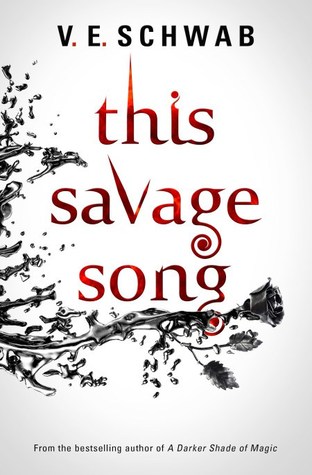
This Savage Song

28696452

Book Title: This Savage Song
Author: V.E. Schwab
Series: Monsters of Verity #1
Date Started: June 19th 2016
Date Completed: July 21st 2016
Genres: Dystopian, Thriller, Fantasy
Quality Rating: Four Stars
Enjoyment Rating: Five Star
Final Rating: Five stars
Review:

I haven't related to a book on a personal level like I did with This Savage Song for a long time. Don't get me wrong, this novel is fantastic regardless, but as an individual who follows Victoria's work closely and has personal mental health conditions this book struck me very hard. And I think it's a very good way to explore mental health without people necessarily knowing it.

This Savage Song, whether it was deliberate or subconscious, has quite frankly staggering parallels to mental health, in both the monsters themselves and the experiences of the characters. Not only am I so happy to see this sort of thing being explored in such a creative way, but I'm also hopeful for what this meant for the author, as well as myself. Victoria is someone who I greatly look up to for countless reasons, but one of which being in how she struggles with some of the things paralleled in her novel: when reading I saw echoes of depression, anxiety, panic attacks. Maybe, once I'd noticed the first few, my own mind starting picking them out for me, but even so seeing those elements there was somehow a comfort - the experiences and feelings being portrayed aren't fun, but it helped me, honestly. However, past the impact this has on me personally, I think it's also a really interesting exploration of mental health in a creative and innovative way - I haven't really seen anyone else talk about this book in terms of mental health, and perhaps I am drawing conclusions from poetic license, but I'd be interested to see what other people thought on its parallels.

A genre that I really don't see that much in the literature I read, but really really love, is old fashioned gangster style crime. Admittedly, This Savage Song isn't really a gangster book, but you gotta love a good old gangster setting, even if it does have a little dystopian twist. And no, it isn't even the main sort of landscape we're in for a lot of the story, but it really does give this book that extra edge. I'm all for corrupt governments in dystopians, but it's rare that I feel the threat these examples of authority pose - but I felt it in Verity. A lot of that's to do with the gradual but clear world building intertwined as part of the story as well as exposition, and part of that's just Victoria Schwab being her usual talented self.
There are some really nice moments in this book that made me gasp; in fact there were points when I found myself genuinely grinning, laughing or staring wide eyed at the page. Some parts might have felt a little more predictable than what I'm used to from Victoria, but there were definitely parts I didn't see coming as well. Overall it's definitely a character story: you invest in the people and they carry things through - if I were to brutally scrutinise it, there was maybe a slight lack of Schwab's usual flair. But even so, I adored every second of this book, and the storyline and climax hold up well for any angle.

I love Schwab's male/female relationships that don't need romance to be intimate. There might always be a hint of something in the future, but in all her books I've found very close friendships and familial relationships that don't require a directly romantic edge to fuel them. First of all, it's a breath of fresh air from what we're constantly being bombarded with in most other examples - but it also does a brilliant job of showing how great it is to have characters stand on their own as powerful individuals. They feel more real, more investable, and like there's further they can go because they haven't had their fate decided for them just yet.
Kate kicked ass. It was pretty cool. She's definitely a flawed and unfriendly hero at times, but again, it's so nice to have a complex protagonist making the wrong decisions and actually paying the consequences. And Kate most certainly pays the consequences.
And in many ways August seems like her polar opposite: he wants to avoid making the wrong decisions to the point where he's scared to do a lot of things at all. Again, a very complex protagonist, but in very different ways. I think it takes a very talented author to be able to write such complicated and conflicting characters, and have their problems and their salvations seem similar to a reader. By the end I just wanted to give him hug, honestly.

Just personally, I'm not a huge fan of school settings, so the first half of this book felt a little bit slow for me at times. There were definitely elements I enjoyed, but it was noticeably slower than what I was used to from Schwab - again, I don't think this was the book, just my personal preference. However, once we got to the middle I could barely put it down. I had to keep reading, I had to know what happened, but at the same time I really didn't want it to be over.

This Savage Song isn't Victoria's most sophisticated book in terms of story line, but her connections (whether deliberate or otherwise) to mental health had a real significance to me, and regardless this book is packed full of action, dystopian adventure thrills. While working as its own story very well, I'm sure it'll expand in the next books, and I'm sure two certain people will find their paths cross again, as always seems to be the case with Victoria's stories.

Image Source - https://www.goodreads.com/book/show/28696452-this-savage-song