Tuesday, 28 June 2016

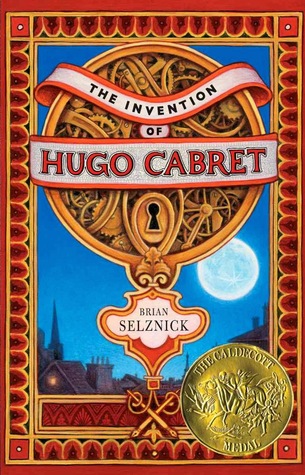
The Invention of Hugo Cabret

9673436

Book Title: The Invention of Hugo Cabret
Author: Brian Selznick
Date Started: June 17th 2016
Date Completed: June 27th 2016
Genres: Mystery, Adventure, Historical
Quality Rating: Five Stars
Enjoyment Rating: Five Star
Final Rating: Five stars
Review:

I don't remember when I first read The Invention of Hugo Cabret, but I do remember it ticking all the boxes for things I loved: books, film, theatre, magic, adventures, mysteries, museums, clockwork etc etc. Hugo Cabret is definitely still my favourite out of Selznick's books, but each one gets across the author's utter fascination and passion for the art of storytelling beautifully. If you want your child to grow up to make stories, these are the books you want to be reading/showing them.

Brian Selznick has a very cinematic way of storytelling; of course his books are all half-told through beautiful double-page illustrations alongside prose text, but the emphasis on things working almost like a play in a set space has always impressed me as well. There's always a limited amount of locations, and a pivotal place that you become really attached to throughout the story and know like the back of your hand. It always strikes me as cinematic because he wants you to visualise it all: be able to literally see the characters moving in this physical plane. It also means that when we come to the whimsical and fantastical elements of the story it feels even more real, because we're been brought so closely to what's happening. He is a children's writer, but his work can be enjoyed by any age range because of this.

Half of this story is told through images: beautifully drawn illustrations by a very expressive artist. I think he could quite easily tell an entire story with just his pictures - but as it is the blend between visual and written storytelling becomes very engaging. There's just enough input from the drawings to be able to clearly picture these characters in the real-life locations, but Selznick is sure to let you have freedom in what you imagine. The fact that he uses real places in a way makes the book feel like a love letter to Paris, even though we don't explore much of the city itself.
For a children's book, The Invention of Hugo Cabret looks at some really complicated emotions, often explored through the eyes of a child. It's the story of a little boy who looks after clocks, but it's also about a man who's dreams crumbled before his very eyes, and the tragedy of the world taking away a form of expression. Even as a child reading this book for the first time, I remember being genuinely moved by Papa Georges' story. Without wanting to spoil anything, he symbolises a golden age within French storytelling, and a revolutionary era within storytelling altogether. Yet he is able to feel none of this because of what the world has done to him in the present: I'm not sure if it's being able to sympathise with his sadness as a person, or seeing it as a storyteller myself but Selznick tells a heartbreaking story - and then turns it into a beautiful, uplifting ending.

Selznick is very natural with his unconventional characters. Calling them unconventional feels a little strange, but stories featuring a man with an eyepatch or a deaf girl aren't that easy to come by. All of his characters are, to me anyway, more genuine and complicated than a lot of people in mainstream children's books these days, but the magic in how Selznick features them is that they so naturally fit into his narrative. He can put them in, and it might be addressed, but he's able to portray the normality of that for the individual.

Each part in this book brings another layer on top of the story. Puzzle pieces start to fit together each time, and something amazing is revealed, but then it comes to light that it's a small part of a whole other story. And the further and further you get in, the more and more invested you come. The use of illustrative storytelling definitely helps the pacing by breaking up the text, but it comes one of those books you just can't put down because you know you're getting closer and closer to finding out what's really been happening.

The Invention of Hugo Cabret is a book that has a little something for everyone, but will especially appeal to storytellers and lovers of film, illustration, magicians and old-fashioned adventure. Selznick fills each word and drawing with magic and mystery and the essence of dreams: if you want a story that will enchant and pull at your heart strings, look no further.

Image Sourcehttps://www.goodreads.com/book/show/9673436-the-invention-of-hugo-cabret

Wednesday, 22 June 2016

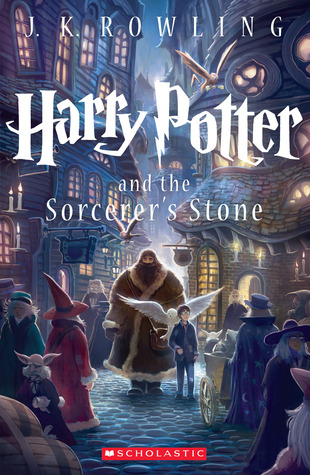
Harry Potter and the Philosopher's Stone

17372039

Book Title: Harry Potter and the Philosopher's Stone
Author: J.K. Rowling
Series: Harry Potter #1
Date Started: June 8th 2016
Date Completed: June 15th 2016
Genres: Fantasy, Adventure, Mystery
Quality Rating: Three Stars
Enjoyment Rating: Four Star
Final Rating: Four stars
Review:


I barely remember anything from my first time reading Harry Potter. My mum read them to me every day after school right up to The Deathly Hallows because it just became a tradition (including my mum reading forward, crying at a certain death, and then spoiling me when I got home before reading it to me - I will never forgive that). But the books came out quite a few years ago, and going into The Philosopher’s Stone again I wasn’t entirely sure what to expect. It ended up with the opening being just as magical as I could imagine, but as I read on things slowed a lot more after the middle.


When talking about Harry Potter to other people I’ve always kind of had a saying that Rowling is a masterful crafter of worlds, concepts and characters, but her writing just isn’t quite on the same level. Rereading the first book reinforced this for me, but at the same time I don’t think it’s necessarily a bad thing. Harry Potter is a book aimed for children, and so the simplistic reading level makes perfect sense, but one that adults can enjoy as well. I don’t think the lack of overt sophistication in the writing style is a huge drawback from the book, and it’s ridiculous success proves that.

Everything I write about this book is in hindsight: these books came out years ago, the majority of the Western world and a lot of the Eastern know the story. But I actually found knowing the outcome of everything that happens took away from my enjoyment of The Philosopher’s Stone on it’s own. Considering how complex the series becomes things like coincidences dotted everywhere and a seemingly random magical system (it gets worked out eventually, but feels a bit sporadic at first) just felt like a bit of a let down. Of course, every author grows with their works and I think the general experience I take from rereading this book is that you can start with a book aimed at children and can end up with a phenomenon that can be enjoyed by everyone.
One of the biggest things I forgot was how important the Hogwarts community and side characters were to the story as a whole. Yes, they don’t have a huge impact on the plot itself, but the mentions of classmates the golden trio spend time with and their individual personalities is a sense of welcomeness at Hogwarts that I don’t think comes through quite so obviously. In the films definitely, but it wasn’t something I really remembered from my first time reading the series either. But it was really the biggest reason why I still love this series: whatever audience you’re a part of, feeling so welcomed into a fictional world is all a reader can possibly ask for.

Rowling has created some of the most loved characters in my lifetime, and I think part of that comes from the fact that they all have their own personalities and genuine flaws. You feel annoyance with Harry at people sometimes, and you’re jealous of their skills at other points: people feel real and distinguishable from one another so of course it’s easier to fall in love with them, and root for them until the very end.
Harry is actually a lot more plain than I remember. And it’s actually a breath of fresh air in an industry that feels like it’s constantly pushing all the unique and strange protagonists it can to the front of the pile. Harry is, for most intents and purposes, normal past what his parents did. Yes, he’s the chosen one, but he comes from a generation of main characters that don't have to fight to be different: he’s strong both as a person and a character from being just Harry, and not needing to be anything more. I think it’s a really good message to send to kids: being weird in your own way is great, but you don't have to be what some people would call extraordinary to be happy and successful.
Ron is undeniably underrated across all platforms. He may be the lighthearted sidekick that gives the group direction every now and then, but he’s a lot more than that too. His character is a lot more complex than I think most people automatically think because of the films and maybe the brighter shine of other characters in the series. He’s genuinely scared of being overshadowed by his brothers; he worries about the fact his family have a lot less money than his friends; he wants to be a good friend but struggles a little to find his identity around the others. Even in the first book he grows a lot, but comparing where he starts to where he ends is a really uplifting story arc.
Hermione was one of the characters I related most to as a child, and I know I’m not alone in that. I think what’s so different about her portrayal of the diligent student is that she’s genuinely shunned for it, and often feels bad about herself for it. I love a clever heroine, and I think it’s wonderful they’re becoming more and more common in books for all ages, but at the time Harry Potter came out it was near revolutionary to have an intelligent female character that was not, at first, held up for her studiousness and determination to learn but continued being that person anyway. Hermione even gets teased by Harry and Ron about being a ‘know-it-all’ but it’s important enough to her that she doesn’t force herself to change, when I think it’s clear at some point that she wants to. As a role model, Hermione is undeniably one of the most influential ones our there in children’s fiction, and it makes me happy that I felt just as much comfort from her now that I did as a child.

Like I’ve said, up to the middle I was just lost in Harry’s world and was reliving the first time I discovered Diagon Alley and Platform 9 3/4 and Hogwarts. But once we were at Hogwarts, and there weren’t quite as flashy things to show off, I really felt like the pace of the book ground to a halt. Maybe that’s a little unfair - I was still reading and it was still enjoyable. But I didn’t find myself unable to put the book down and I wasn’t racing to get ahead. Admittedly, the book becomes a lot more plot-driven after the midpoint, and knowing what’s going to happen does lessen the effect as a consequence, but even so I would’ve liked to be stuck to the story a little more than I was.

The Philosopher’s Stone is great fun, and the essence of fantasy adventure for kids, but it’s nothing compared to where this series goes. It isn’t really a criticism: it’s wonderful the books grew with their audience and came so developed and complex, but rereading it I have to be honest and say I was a little disappointed.

Image Source - https://www.goodreads.com/book/show/17372039-harry-potter-and-the-sorcerer-s-stone

Tuesday, 7 June 2016

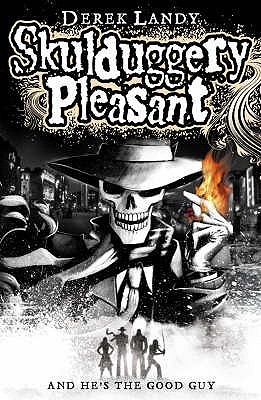
Skulduggery Pleasant

924059

Book Title: Skulduggery Pleasant
Author: Derek Landy
Series: Skulduggery Pleasant #1
Date Started: June 6th 2016
Date Completed: June 7th 2016
Genres: Fantasy, Mystery, Action, Thriller, Horror, Adventure
Quality Rating: Five Stars
Enjoyment Rating: Five Star
Final Rating: Five stars
Review:

Let me start with a little ramble about me before I start a longer ramble about this book. When I was about eight my mum won a book for me and that book went on to become my Harry Potter - don't get me wrong, Harry Potter  was a huge part of my childhood too, but Skulduggery Pleasant grew up with me. Val was only a few years older than me and these books ended the year I had to start thinking like an adult; about university, and jobs, and money. Skulduggery ending was like me kissing my childhood goodbye, and yes I sobbed when it finished. So when I decided to reread the series during my final A Level exams I was kind of terrified it wasn't going to be what I remembered through those rose-tinted glasses before debt and uni because a thing. I needn't have worried. It was everything I remember and more.

Derek's writing is very vibrant and vivid without needing to be overly descriptive. I think it's mainly because he knows his characters inside out, so he can immediately show their mannerisms and relationships to others and the world without needing to explain too much. It's also some of the only writing that genuinely makes me laugh out loud - as someone who's been rereading parts of this book for about a decade, there are jokes I'm so used to that still actually make me laugh.
The world building in the series is also very solid, despite the fact that it ends up as the most basic foundations for what the universe becomes. We have thought-out magic systems, believable politics, and classic hidden rooms, sacred artefacts and mysterious books and keys and weapons floating about the place.

I've never been able to quite put a genre on Skulduggery and its story without stringing together adventure-action-mystery-fantasy-film-noir-and-horror into one terribly named hybrid. It's got a little bit of everything and somehow it'll make you love every part of it, regardless how you get on with each individual genre. I'm not a horror-lover, but I appreciate the creativity of a right hand without skin that can literally kill people just by pointing it at them; I'm also not so attached to classic adventure, but there's something indulgent about the reckless freedom Stephanie has in the book. There isn't really a way to explain these books without saying they're a combination of so many different things weaved so seamlessly into one another.
Like I've said already, this series grows into a much more complicated and dark tone as the story goes on, but you know I often don't give enough credit to how mature and well-crafted the first book is itself. I know things get more brutal, but Skulduggery Pleasant isn't a walk in the park either. It treats serious subjects with respect but also allows it to be understandable and accessible for younger readers. When you throw in its unpredictable nature with brilliant twists, a genuine tension and threat, and an awesome climactic battle, there isn't really much more you can ask from a book about skeleton detective and his magical world, and the little girl caught in the middle of it.

Skulduggery Pleasant's characters are really the high points of his books. Each one has their own personality, and each one is as phenomenally developed and executed as the next. He doesn't hesitate at including genuinely unpleasant people, or painfully normal ones, or absolutely exceptional individuals: he's writing a world, and in a world there is this brilliant diversity that instantly lifts everything up as more believable and engaging.
I forgot how normal Stephanie was to start with. That feels weird to type out even as I write this, but she really is just a girl who gets caught up in a huge world because she got on well with her uncle, but happens to have enough determination to make a difference in it (and it's not brute stubbornness or recklessness, it's actually intelligent determination - I'm getting rather bored of the stubborn and reckless but frankly stupid protagonist who saves the world mainly through luck lets be honest).
There isn't too much to say about Skulduggery past that he's just as much of a mystery at the start as he is at the end, but you love him anyway. He might be a little more subtle with his arrogance here though. Smooth bastard.
And though she doesn't come into her stride until later in the series, I did want to mention Tanith. I don't think I appreciated her position as an outsider who has to make tough decisions when I read the book years ago. But having come through the series with her being one of my favourite characters, and looking back in detail at her here has given me a real appreciation for how Derek writes women. Not just Tanith of course, but I've always connected with her especially, and the way that I've seen her be developed so much farther than I'm used to, and in ways that you don't often see from female characters in long series like this just reminded me how much I admire Skulduggery for its quality, as well as enjoyment.

The pacing was really good the whole way through. We start off quite calmly but with a clear sense of atmosphere heading towards the gothic suspense genre, and almost immediately tension and mystery starts building pretty consistently. There's never a useless of boring chapter, there's always something important or interesting happening; a good balance between action and dialogue, drama and humour, light-hearted and darker moments. Derek's very good at structuring his stories so whenever you break off or jump back into the story, you're pulled right back into the middle of the chaos, but you're still in a good position to understand what's happening.

There's something for everyone in this series: action, mystery, humour, fantasy, the list goes on. It's one of those books I skim read all the time whenever I'm bored or need a pick-me-up and it's so easy to fall into. As the first book in the series, it's inevitably a little lighter, quicker and simpler than what the series becomes, but it's still so, so, so good.

Image Source - https://www.goodreads.com/book/show/924059.Skulduggery_Pleasant

Sunday, 15 May 2016

The Reader on the 6.27

29501558

Book Title: The Reader on the 6.17
Author: Jean-Paul Didierlaurent
Date Started: May 13th 2016
Date Completed: May 15th 2016
Genres: Contemporary
Quality Rating: Four Stars
Enjoyment Rating: Five Star
Final Rating: Four stars
Review:

◆ Thank you NetGalley for this eBook copy for review ◆

The Reader on the 6.27 was a really lovely book. It's been a while since I've read something so calm and sweet and purely enjoyable. This is a story that doesn't propel you through excitement and danger, but lets you float gently along the plot about a man torn between his love of books and working in a factory that churns them up to make new ones.

Didierlaurent's writing style is nice and fluid and works particularly well in the thoughtful first-person narrative. But there are also extracts throughout the books of pages Guylain has saved from his workplace that (I assume anyway) are also written by the author. The writing style is genuinely a little different each time, so you get this nice diversity of style that I'm impressed came through so well after translation.
In fact the book as a whole has been very well translated: from the flow of the words to the little cultural things that are tweaked to make a bit more sense outside of France. Although I obviously can't compare it to the original since I can't read French, I think Schwartz has done a really good job bringing the book to life in English.

You can tell this book is originally French through its style - there's definitely a couple of strange, quirky moments that just had my mind replaying Amelie again and again. I really liked this, and it unintentionally sent me back into the mindset I'm always in when I go to France, and Paris in particular. But at the same time it's such a subtle part of the book that I don't feel like it overwhelms the actual story with its nationalism - if you aren't aware of French culture, you can still settle into this story, and you might learn something along the way.
On top of its French identity, The Reader on the 6.27 is one of those stories where you can feel the love of books through the pages. Again, it isn't necessarily the primary focus of the entire book, but it creeps in at all the corners. The characters love books, and the plot welcomes stories in at every turn, whether it be from the books or Guylain's thoughts or little anecdotes from the people.
While there isn't a huge climax to build up to in the end, there's a heartwarmingly satisfying conclusion and that lingering feeling of comfort even though you've had to say goodbye to the characters.

This book has a lovely little assortment of characters, and while they don't really stand out overwhelmingly as individual, together they fit wonderfully into this story. It's all led by Guylain - a likeable man in his thirties who ends up helping other people through his own little indulgences like reading aloud on a train in the mornings. But around him there's a host of other nice people that come into his life in various ways: the people on the train, those he works with, other people he sees everyday on the streets, and finally a girl he knows only through the files on a USB he finds. I keep thinking of how they all fit together like characters in a fairytale: none really meant to work in any old world, but lovingly crafted for this one.

It's short and sweet to fit perfectly with the book's overall feel. Didierlaurent didn't need to draw the story out, but he still gets you invested in these loveable characters very early on. I was comfortable to stroll along with the rhythm set, even though it's a lot slower than what I mostly read.

The Reader on the 6.27 was exactly the kind of book I was looking for: relaxed, sweet and loveable. I love my fantasy adventures, but sometimes it's nice to just take it a little slower. This book was a contemporary without the over-fluffy romance or the stereotypical family problems. Just a quiet little tale that didn't need to shout to make me enjoy it. I would definitely recommend it to anyone wanting just a gentle break from the big loud world.

Image Source - https://www.goodreads.com/book/show/29501558-the-reader-on-the-6-27

Tuesday, 26 April 2016

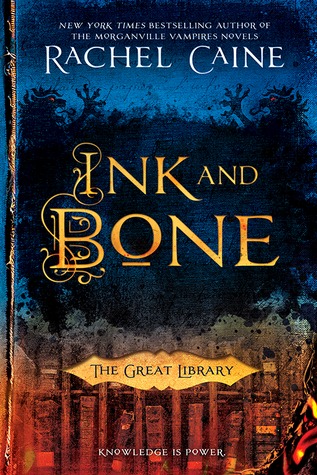
Ink and Bone

20643052

Book Title: Ink and Bone
Author: Rachel Caine
Series: The Great Library #1
Date Started: April 20th 2016
Date Completed: April 25th 2016
Genres: Fantasy, Adventure, Mystery, Romance
Quality Rating: Four Stars
Enjoyment Rating: Four Star
Final Rating: Four stars
Review:

◆ Thank you NetGalley for this eBook copy for review ◆

Honestly, I underestimated Ink and Bone when I started reading. The first half wasn't really encouraging me to think differently because of it's slow pace, but suddenly halfway through things really picked up and it became a really entertaining and quick read. By big downside to the book as a whole was that it felt a lot like a prologue to the sequel.

The world building was both a strength of this book, but also a weakness for me if I thought about it too much. Obviously, the way to solve this was to not think about it too much, and once I accepted that I was able to dive into the story a lot better. Caine's captured a nice blend of mythology and traditional adventure-mystery worlds, but I don't feel like the futuristic/alternate-history genre really came into it. When I started reading I imagined a 19th Century setting, only to find out it's more of a dystopian civilisation. For me that element didn't fit very well, and also didn't need to be there: because it's an alternate history where the Library of Alexandria never gets burnt down, I don't think we needed to know exactly when it was set - or if she was trying to show how this regressed our society I didn't feel like she looked at it enough. Overall, I wasn't sure what Caine was trying to do, but like I said: just don't think about it too much. But even with some of the inconsistencies at the back of my head, I honestly did find Ink and Bone enjoyable to read. I can't even pinpoint what made it so, but I'm really eager to get onto the next one.

Ink and Bone takes its time to establish what it's doing, but it definitely makes up for it in the end. I was getting dubious at the competition/school phase when I could predict exactly who was going to get through to being a Librarian (shocker: I was right), but then Caine twists things around and we're on a different path. This happens a couple of times, so if you aren't sure about this book to start with, keep going because it gets interesting pretty quickly.
A big part of what makes Ink and Bone enjoyable are the relationships, but I really liked how they weren't the main aspect of the story. The cute little pairings and friendships are really sweet and enjoyable to read about, but because they're placed in the background it lets them stay sweet as opposed to sickly. Caine could've quite easily dominated the text with romance or family relationships, but she let the story tell itself as a priority, and let us enjoy all the characters' interactions on the side.
I didn't feel like there was really a big climax past the cliffhanger, but I think the story (past the halfway mark) is consistent enough in its tension and excitement that it doesn't really matter. Climaxes tend to resolve problems set up in the narrative, and there aren't really any issues Caine can solve in this first book. Instead she communicates the transition into another part of the characters' story and leaves us wanting more.

I really liked the diversity of characters in this book, and I'm kind of conflicted because I really liked how they were just naturally diverse without it having to be their token trait in their personalities, but at the same time I really wish they could've been more at the forefront of the story. Our protagonists are very much the norm, with the range of diverse characters in secondary roles. I'm not complaining too much since the range of nationalities, sexualities, personalities and genders were really nice to see, I'm just... considering the unused potential they had.
Jess was a good protagonist, but as usual not extraordinary. I think his main strength was being able to see things from different perspectives and really adapt: he's not the same person at the start that you find after he's gotten to know what the Library is capable of. To be brutally honest, I'm not sure if this was exactly planned character development, or more what Caine twisting her protagonist to get everyone to the end of the book, but either way it still worked in terms of the story and didn't pull me out of narrative with its convenience.
I also really liked Morgan. Her introduction into the story is a little unconventional and I was confused at her exact involvement to start with, but she soon proves herself. Essentially how Caine sets things out at the start of this book don't make a whole lot of sense when you're reading it, but by the second half things slowly start to click into place. From a reader's perspective I'm not sure how well it was done since I did doubt lots of things to start with, but I can understand why Caine hides details and secrets from the reader.

Like I've mentioned, this book is very slow to start with - not necessarily boring since you've got some nice characters and an interesting world, but it did make me wonder where the story was going. Of course, once Caine lights the fuse it gets serious very, very fast. I flew through the second half in the way that actually, I didn't really want to put the book down.

I enjoyed Ink and Bone a lot more than I was expecting to, and I'm actually really eager to get onto the next book when it comes out later this year. If you like fantasy, a little bit of adventure and mystery along with some cute characters and books (oh, the books) then it's definitely worth putting it on your shelf.

Image Source - https://www.goodreads.com/book/show/20643052-ink-and-bone

Thursday, 21 April 2016

Inkdeath


Book Title: Inkdeath
Author: Cornelia Funke
Series: Inkworld #3
Date Started: April 8th 2016
Date Completed: April 20th 2016
Genres: Fantasy, Adventure, Romance
Quality Rating: Five Stars
Enjoyment Rating: Five Star
Final Rating: Five stars
Review:

Inkdeath is a living, breathing fairytale on a larger scale. There are so many little reminiscent details, but it's all strung together by Funke's entirely original and stunning imagination. I've waited a long time to read this book - I read Inkheart when I was about seven or eight - but the second I opened the page I was entirely lost in the Inkworld again the whole way through. I didn't notice it was taking me a while to read or that it was so long, because I wasn't there to notice the page numbers, I was in Ombra, or Elinor's library, or in the Black Prince's cave, or in Violante's castle.

Funke's love of books and storytelling is so tangible in her writing that it makes it impossible not to fall in love with reading all over again. If anything, Inkheart and its sequels are a love letter to books and stories, for children and adults, girls and boys: 'books love anyone who opens them' and it really comes across.
The writing is very traditional in terms of the kinds of roles available for each character (e.g. women, children etc), but Funke acknowledges this and still finds little ways around it anyway. For example, there's always a little sign in the children's voices when they know that they can't be the heroes of the story, and that the Bluejay has to do that for them, but they can still fight and they do. Just little ways around things like that show that you can still use traditional conventions without marginalising people (which is I think something we still struggle with sometimes in storytelling).

The Inkworld series is based a lot around world building , so I was happy to see that Inkdeath both worked well with what had already been established, but also was able to take steps forward from the previous books. We get to discover more but still explore the storylines already in place.
You can see on every page just how much inspiration is taken from fairytales, but I also noticed how much Funke has taken from more modern books as well - the quotes at the start of each chapter name influences like Ted Hughes, Philip Pullman, Markus Zusak etc, but I could feel all the different influences in the writing too. Funke's own style is very much in centerstage, but its nice being able to pick out all the various other aspects you can recognise from all over literature. Not least because you're reading about people from our world that have found themselves lost between the pages of a book. And in the best way possible, Funke does this with sophistication: full of the magic and elegance of traditional fairytale, but with the magic and wit of a child's imagination. This isn't your average children's book.
The final climax of Inkdeath wasn't as dramatic as I had hoped, but the book had the most wonderful epilogue I've ever read. Inkdeath, for me, stays at a relatively similar level of tension and excitement throughout, so the finale didn't burst out of the pages as maybe I was expecting, but the fact that when I closed the book I felt so satisfied at how everything had drawn together was more than enough for me.

Inkdeath is the kind of book where every character is meticulously crafted and perfectly chosen, and who you can't help but love, even if they're not a good guy. On top of that you have all the layers of relationships they have with everyone around them, which are all heartwarming to say the least. Without going into spoilers, Dustfinger has 100% been the best character of the entire series and he will be one of my most beloved fictional characters forever.
I've always liked Mo, but I don't think I'd ever really connected with the main protagonist of these books as much as I did in this one. I think his confliction between being the bookbinder, and the Bluejay that Fenoglio had written him as was the game changer for me; as much as perfect Mo is great, seeing his dark side was really interesting.
Meggie is just as much as protagonist as her father of course. I don't feel like she had as much of a role as she had in Inkspell, but her presence was still a key part to the book, and a key part to showing us how beautiful the Inkworld is. You might have Mo running around for his - and everyone else's - life, but getting to see the Inkworld in all its glory again from a slightly (only slightly) less dramatic angle gave that good balance that kept my motivation to read up.

Pacing-wise Inkdeath was just right: it isn't the kind of book that is unputdownable because of the constant state of drama, but at the same time the sheer amount of different stories happening at the same time, all converging on one point means that every time you get to the end of a chapter and have a peek at the next one, you just want to keep going. I didn't get bored at any point, and I was completely lost in the story the whole time.

The Inkworld trilogy is one of those series that I can always go back to and feel comforted by. Even though it's over it's still like Hogwarts in the way that I can go right back to it whenever I need it. Although Inkdeath itself didn't overwhelm me with emotions I still loved it, and thought it was a wonderful end to the story. Part of the reason I wasn't overwhelmed by it was because of how comforted I am by it: doesn't matter if you're in a life-threatening situation, I feel a home in this world (which is ironically the same predicament as quite a few of the characters so it evens out in the end).

Image Source https://blogger.googleusercontent.com/img/b/R29vZ2xl/AVvXsEhDQcCA-OqQnHbnt2no_obJ0Udo2bXlphbzsEIgEiLj7E0jL6NDFB-Ty_s_hbJ5gPQM5AE4_hM4RWdlyjF78Pkgtw8y38UyQcEBgSCJyRwfT8tjE1tlpVoIU87deOELesc65IAbUUf0AhzA/s1600/2325825.jpeg

Friday, 8 April 2016

Red Rising

18046624

Book Title: Red Rising
Author: Pierce Brown
Series: Red Rising #1
Date Started: March 28th 2016
Date Completed: April 8th 2016
Genres: Dystopian, Action
Quality Rating: Four Stars
Enjoyment Rating: Three Star
Final Rating: Four stars
Review:

Red Rising wasn't nearly as original as I was expecting, but at the same time I'm still conflicted because it was a good book. At one point I thought it was that the world and story were brilliantly established but the characters werent puling through, but I'm not so sure anymore. Overall, I was interested, but I didn't care what happened.

I'm still not sure where I stand with Brown's writing: the action felt a bit condensed and heavy without saying much, but was definitely exciting; there isn't much dialogue thinking back on it, but what was there felt reasonably natural; the narration takes up most of the book but that in itself isn't too boring and actually gives relevant information to the story as opposed to rambling about something that only has meaning for the author. But the fact that most of the written skill was around explaining the military manoeuvres and the gory ways each leader was rising to the top but without any real meaning, it felt a little bit of a big boys game version of Lord of the Flies without much consideration on the other elements making up the book to back it up. It wasn't bad - Brown surprised me with his fluency - but I think it focused on some strange areas given the overarching story it was going to tell.

Red Rising is arguably built on its politics and social ideas. I generally love these kinds of books, and after pushing the unavoidable comparisons to every other Young Adult dystopian out there from my head (primarily The Hunger Games, Divergent, Uglies etc), I found a few new things in the wold building. Having said that, I don't quite understand the reasoning of quite a few methods used by this government - and the class/race system especially confused me. The Golds WERE different to the other class/races below them; it takes multiple surgeries to become one of them, so what was the moral point? I feel like there should be a social context we can relate to in all this, but I can't find the right angle for it. You can't say that all the races are the same, because they're practically different species here, but I can't see how it's implied that Reds are just as valuable as Golds: it's almost like Brown was confirming the Gold hierarchy beliefs.
This book also relies quite a bit on little revelations scattered throughout the whole thing - partially to show how clever Darrow is, but also to show how corrupt the system is. But I felt like some of these were just for the author, and there was no way the reader would've seen them coming or worked them out. Maybe I was really detached so didn't pick up the hints, but either way feeling like I wasn't really going to be given a chance to think ahead of the characters pushed me even further from the story because it felt like I was just an observers, as opposed to being able to problem-solve some stuff myself.
After all my issues with Red Rising, I still got completely immersed in the ending. You definitely get caught up in it and forget what's really going on behind all the scheming and games, so the resolution of the story on its own is almost a surprise - even more so when you remember what Darrow is building up to in the trilogy as a whole. Regardless of how hard I found it to get into, I really want to know where it goes from here.

The characters in Red Rising don't seem as strong or consistent as anything else (especially female roles - I was really disappointed by those actually). There just doesn't seem to be much substance under anyone, and even if there was Brown isn't one to keep people around the main plot line for long. I understand that people fall in and out of power (it was a good element of the story), but it felt like it was there partly to cover them randomly disappearing in the writing because the timing of a lot of them just didn't make sense given the circumstances. Really, I'm just frustrated because there was a lot of potential in some of those characters, but everything was sacrificed for Darrow.
Darrow himself was a mediocre hero at best unfortunately. He's a great leader, and incredibly important, but as a main protagonist he's a bit bland - he's very sure of himself a lot of the time, and rightly so. And while it's nice to have a protagonist who knows what they're doing, it makes for a bit of a slow story. The big thing with Red Rising is also the fact that Darrow is literally the only character who's consistently around, because we have to be inside his head. But no one else is around beside him consistently, and while this keeps things changing, I honestly wanted to see some more development from people who weren't as confident or skilled as Darrow. Darrow nailed the whole thing - now I want to see people mess up and how they deal with it.

Honestly, I didn't enjoy the first part of this book at all, but it's really important to set everything up. While I don't think books that sacrifice their openings to world build are skilfully written, I admit that when things kicked off it was much better knowing all the foundations to really understand what was happening and why it mattered. Having said that, there was something missing from keeping me glued to the story. All the way through I found myself falling in and out of interest and I'm still not sure why - I just know it definitely made it harder for me to feel engaged in the story.

I'm eager to see what happens next to Darrow; it feels like one of those stories that almost goes into a whole different world in each book, but I'm wary of all the hype surrounding the rest of the series. Red Rising wasn't what I was hoping for, but once I'd accepted that the little inconsistencies and strange orderings of the world I was able to find some good entertainment for the last hundred pages that was eventually enough to make me want more.

Image Source https://www.goodreads.com/book/show/18046624-red-rising